
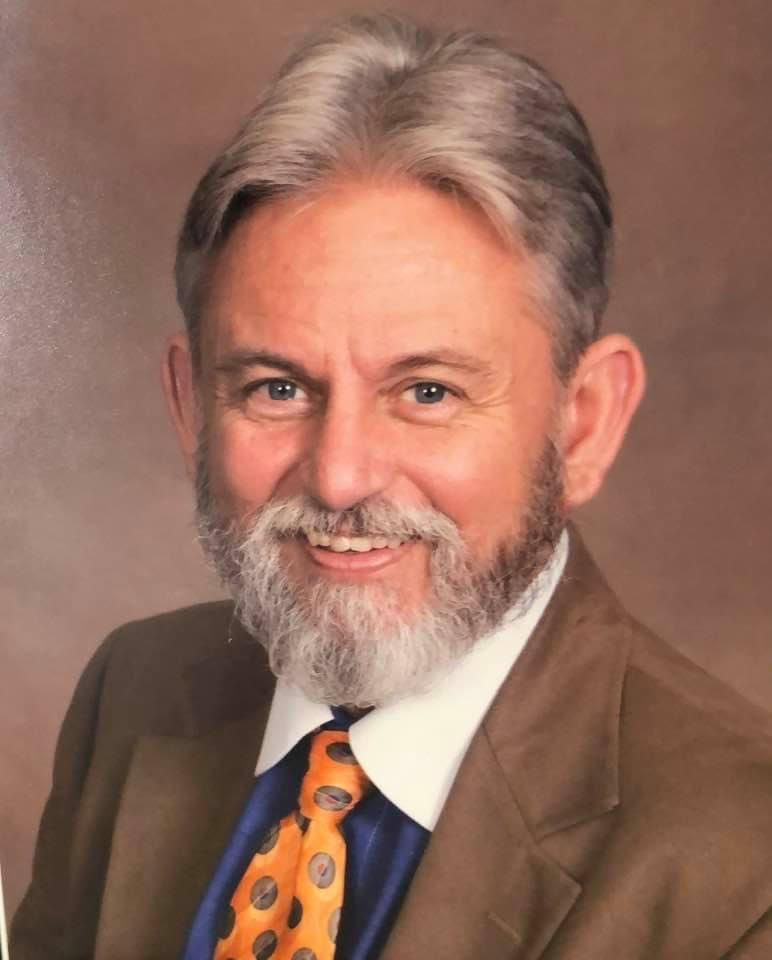
bRIAN wAYNE lIECHTY
JUNE 19, 1958-MARCH 30, 2021
Browsing in the local small-town stores the week before my step-son’s funeral, I saw a wooden placard – the kind the man in the Progressive commercial makes women throw away. The sign said: “Every Family Has a Story.” And I thought, “Boy, ain’t that the truth! Our family is a patchwork quilt of relationships by birth, by marriage and remarriage, and by forever-fostering. Did I mention we have FOUR Brians (well, 3 Brians, one Bryan)? Yet, somehow, we have managed to navigate the challenges of blended families for 40 years this July. That’s the Biblical number of completion, so I feel like we’ve truly made it work!
I had been Brian’s stepmother since 1981, so I prayed for him like any mother prays for her son to live. Many people in our Indiana hometown joined our family in asking heaven’s dispensation from the ravages of this pandemic. And yet he died. Covid is a national tragedy for so many families, seemingly visiting severe reactions with little rhyme or reason. Our family is no stranger to grief — as friends and visitors to this blog well know. Yet, each death, like each birth, changes and challenges us – gives us new problems to solve. One of the tempting problems of tragic loss is to ask, “Why? Why him? Why us? We prayed so hard!” When we don’t get the answer to our prayers that we want, we feel entitled to be angry at God (which God understands, I believe, and isn’t angry in return). We are tempted also to believe we can never be fully happy again – or believe we shouldn’t be (which is sort of the same as being angry at the Giver of Life).
Being ever the English teacher – I thought of the quote from Leo Tolstoy:
Happy families are all alike; every unhappy family is unhappy in its own way.
Leo Tolstoy
It seems crazy for an English teacher to disagree with a world renowned author, but Tolstoy got it wrong. He presumed there was something called “the happy family” in which life is only sweetness and light, a place where everyone gets along perfectly, with no dark undercurrents, no closets with skeletons, and no tragedies. But our family story challenges Tolstoy’s belief. Happy families are not ones that never have hard times. Life is very fair. It breaks everyone’s heart. Every family gets a turn at heartache and trouble. But in my view, happy families are those who face life’s tragedies and overcome them together.
The six weeks of my son’s suffering were a long and difficult struggle in our family – especially for his wife, his four adult children, and his eight grandchildren. None of us was ready for his death. Not only were we surprised by his loss, we were amazed at some eerily synchronous circumstances. When I began the process of publishing my book Cecropia last September, I had no way of knowing that our own family would need the story as part of our own healing from loss – again – or that the books would arrive just prior to his death. I had no way to know that the happenstance of architectural weaknesses in Brian’s family’s church building would require their services to be held in the neighboring church — the very place where Brian’s dad (my husband of nearly 34 years) served the church and the community for a decade and a half. The Universe seems to love irony. And, ironically, grief teaches us to appreciate serendipity, even when the journey is difficult. To share Brian’s farewell in the same sacred space in which we celebrated the lives of my mother and husband, where children were married, and their babies baptized, felt like a special orchestration, an unexpected spiritual blessing in the midst of pain.
Finding happiness in the midst of sorrow was a specialty Brian Liechty understood. Few outside the family know that when Brian was four years old his baby sister Sheryl was born with a congenital heart problem. There was no wall properly separating the right and left ventricles of her heart, so her blood was not properly oxygenated. Her lips, hands, and feet were always a disturbing shade of blue. At her six weeks check up, doctors said she would not survive until the age of two. She lived to age fifteen. The intervening years were full of medications, surgeries, and hopes for the progress being made toward the availability of a heart transplant. She died in 1977 just shy of that availability being realized. That fifteen year struggle shaped Brian’s framework for his own life. He learned how to be the family cheerleader, the family clown, and the family sparkplug.
Brian’s dad used to brag, “When my son comes in, the room lights up!” Whenever our phone rang, I could tell by the sound of Ron’s voice when it was Brian on the other end. Ron’s voice just sounded different when he talked with his beloved son – it was the timbre of joy. I am certain that some of his joy came from Brian’s lifetime of antics. Ron loved telling the story about the year his children received pot-holder looms for Christmas. He said the holiday soundtrack switched from “Jingle Bells” to “Over, Under, Over, Under” as Brian coached his baby sisters to create an inventory of pot holders he then sold to their neighbors. Then came his projects – like ceramics, puppet making, guitar lessons, and working towards his Eagle Scout badge. Brian enjoyed helping Sheryl make and sell her creations. He entertained. He provided distractions from the ever-present impending sense of doom. Brian the energetic, caring, entrepreneur developed the very qualities everyone loved about him within his nuclear family’s tragic story.
I think, in those early days, Brian developed a talent for recognizing broken hearts that needed cheering up. When anyone was hurting, Brian’s arm went around that person’s shoulder, or they joined him in laughing at himself, or they’d have to chuckle at his bad joke. Brian’s own experience of sorrow taught him that laughter was indeed the best medicine.
I think Brian also understood that working together toward a common goal required a never ending list of projects to keep everyone focused and hopeful. Brian was often first in line to volunteer whether it was working to build a community playground, constructing a community theater set, coaching a kid’s softball team – or helping a shuttered church rebuild its dome. Brian’s life is a testament to the impact of Sheryl’s legacy. I would not dare call either of their lives a “tragedy.” I celebrate instead their miraculous capacity to overcome!
All of us wish that life was easier, less random. But at heart, I am more of an M. Scott Peck level of philosopher: “Life is difficult; once you accept that fact, life gets much easier.” I want my grandchildren to remember that from his childhood, their dad and granddad embodied what to do when life brings you problems. You don’t question, “Why has such tragedy befallen me?” But instead ask, “What can I do with my life to help others?”
What did Brian want from life? Like his Grandpa Liechty in South Bend, Brian’s dream was to own a business on Michigan Street with the Liechty family name proudly on display, a dream he essentially realized – in Plymouth, Indiana. He wanted a home where his family could gather and share memorable times. His children and grandchildren know how much of himself he gave to see that they had what they needed, that they had many opportunities for fun. More than anything Brian wanted people not to hurt or lose hope.
The good news of our family’s story is that Brian’s legacy can also be ours. Despite Covid, despite our loss, we are still a “happy family.” Leo Tolstoy was wrong. Happiness is not based on who has problems and who does not. Happy families are those who overcome tragedy and imperfection with faith, with love, and with hope. That’s why it’s important in the midst of pain and tragic loss to say, “Joy wins!” We can choose to acknowledge tragedy, but not let it define us.
We cannot control the bad things that happen in life. But we can learn, like Brian did, that we can make life better for others and in the process create joy for ourselves. Joy is even better than happiness, because joy can exist even in the midst of our sorrow. And that’s the message of our loss. We are sad because we miss him; but we’re glad because we knew him! And on top of that, each Easter we will be reminded that the energy behind that smile and those hugs remains with us. Our deep pain reminds us of our great love for him. And love is eternal. Finally, because we are Easter people, we understand we will see him again. What a joy that will be!
 In it for the Long Run